


People-centered leadership: Astrid Jairam on Situational leadership
For Astrid Jairam, Recruitment Manager Multilingual & Large Accounts at Exactpi, the essence of her leadership style is putting people first. We spoke with her about the power of situational leadership in international teams.
Share blog
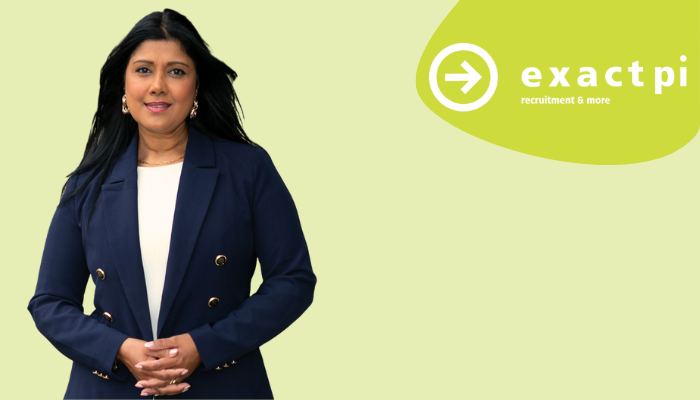
When you bring more than 25 years of experience in HR and recruitment, you know it’s not just about résumés and processes—it’s about people. For Astrid Jairam, Recruitment Manager Multilingual & Large Accounts at Exactpi, this is exactly the essence of her leadership style: putting people first. Since taking the lead of the international recruitment team, she has applied situational leadership in everything she does.
A new chapter in leadership
Although Astrid had gained leadership experience in previous roles, her position at Exactpi marked a new phase. “It was the first time I managed on this scale and in an international context. That required me to reassess my approach.”
She quickly noticed that a one-size-fits-all method didn’t work. “What someone needs depends on their experience, personality, and the circumstances at that moment. A new hire requires more guidance. An experienced recruiter, on the other hand, needs freedom. You have to recognize and acknowledge those differences.”
She uses tools such as TMA and DISC, which provide insights into behavior, drivers, and preferences. But for her, true leadership starts afterwards. “A profile is a starting point. It shows how someone is wired, but it doesn’t tell you how they’re feeling today. Maybe something’s going on outside of work. I always take that into account in my approach.”
Leadership starts with yourself
What stands out in Astrid’s style is how consciously she uses herself as an instrument. She doesn’t speak in management jargon, but in human language. “I try to just be myself in conversations. Open, honest, and vulnerable when necessary. Because only when I show myself, do I invite others to do the same.”
According to her, that authenticity leads to greater trust and stronger collaboration within the team. “You notice that people dare to speak up more, give feedback more easily, and make each other stronger. You see that reflected in both engagement and results.”
It’s all about balance, she says. “A good leader knows when to challenge someone and when to provide support. If you sense that well, not only does the other person grow—you grow together as a team. At the same time, I never lose sight of the organization’s goals: personal development and team growth must always contribute to the bigger picture.”
International dynamics: Culture and connection
The transition from the Dutch to the international team brought new insights—not only because of language differences but especially cultural differences. “Dutch people are naturally quite direct. In the international team, communication styles sometimes differ. People may be more cautious, more accommodating, or more polite. That calls for a different tone and approach.”
Astrid deliberately chooses an approach rooted in mutual understanding. “It’s important to reflect on someone’s background, habits, and expectations. At the same time, I help them understand how we work here… Together, you find a way of working that feels right for everyone—without changing anyone, but also without losing yourself.”
What works universally for Astrid, however, is respect. “If you approach people with kindness and openness, you get far. Everyone wants to feel seen. That’s where it all starts.”
Future-oriented leadership
The world around us is changing rapidly: technology, AI, hybrid working, increasing cultural diversity. This requires leaders to remain agile.
“Especially now, situational leadership isn’t a ‘nice to have’—it’s a ‘need to have,’” Astrid says. “As a leader, you need to switch between styles: coaching, delegating, directing. And you need to explain why you’re handling things in a certain way. Transparency in that is crucial.”
She also stresses the importance of continuous reflection, including on your own role. “Ask yourself regularly: what does this person need? What does this situation ask of me? And how can I make a difference in it?”
The power of attention
What Astrid Jairam shows is that leadership doesn’t necessarily start with grand strategies or management models. It starts with attention: attention for the person, for the context, and for the moment. This approach not only makes her an effective leader but also a role model for others in the field.
Situational leadership plays a key role here—not as a theory pulled from a book, but as something that has become second nature. “Every situation is different, and every colleague is different. You need to adapt if you want people to grow and feel seen. If you truly look, truly listen, and take people seriously for who they are and where they stand, space opens up. Space to grow, to collaborate, and to move forward together. And that, I believe, is what leadership ultimately is about,” she says.
Learn more about Exactpi Recruitment
Curious about what Exactpi can do for your organization? Feel free to contact us for personal advice or an introduction. We’ll gladly think along with you about the best solution for your recruitment and workforce flexibility needs.




Also take a look at

Applying for a job in the Netherlands? Discover smart…

International Recruitment Consultant Alex Pop shares p…